
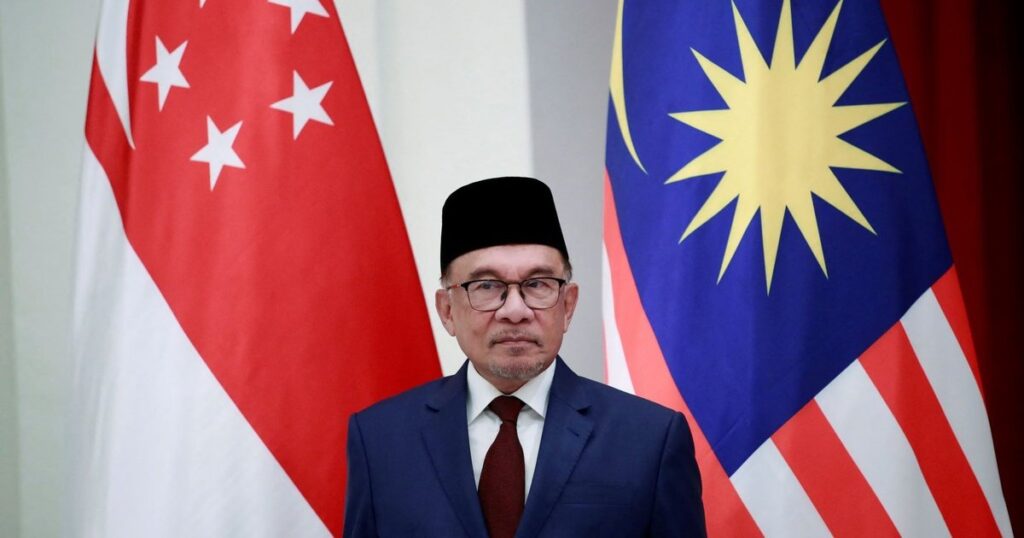
KUALA LUMPUR, Malaysia — Prime Minister Anwar Ibrahim has unveiled a significant cabinet reshuffle aimed at strengthening his administration’s ability to tackle Malaysia’s economic headwinds and improve governance performance, according to a statement issued on December 16, 2025.
The shake-up follows a period of political uncertainty marked by the resignations of key ministers earlier in the year and ongoing public concerns over inflation, the cost of living, and sluggish reform momentum. The Cabinet restructuring underscores the government’s intent to realign priorities and bolster policy implementation ahead of mounting economic challenges.

ADVERTISEMENT
Who’s In and Who’s Out
Among the changes announced:
- Johari Abdul Ghani has been named New Trade Minister, replacing Tengku Zafrul Aziz, whose senate term recently expired.
- Akmal Nasrullah Mohd Nasir takes on the role of Economy Minister.
- Arthur Joseph Kurup has been appointed Minister of Natural Resources and Environmental Sustainability.
Several other ministries saw reassignments and new deputy minister appointments as part of the broader overhaul.
Prime Minister Anwar Ibrahim emphasized that the reconfigured Cabinet is designed to foster better teamwork across ministries and enhance the government’s ability to respond effectively to both domestic and global economic pressures. The changes come amid projections that Malaysia’s economic growth will moderate in 2025 and 2026, influenced by global trade uncertainties and shifting market dynamics.
Strategic Priorities: Economic Growth & Reform
During the announcement, Anwar outlined that the reshuffle was not merely cosmetic but aimed at strengthening leadership in key sectors such as trade, economic planning, and environmental policy implementation. Analysts say the move is part of a broader strategy to reassure investors and the public that the government remains focused on sustainable growth and structural reform.
The economic portfolio, now under Akmal Nasrullah, is expected to play a pivotal role in shaping fiscal policy and navigating headwinds including inflation, global supply chain disruptions, and shifts in foreign direct investment trends.

Reaction and Political Context
The cabinet reshuffle comes ahead of a series of regional elections that analysts say will serve as a litmus test for the government’s public support. With national polls anticipated by 2028, the timing of the reshuffle appears strategically aligned to signal stability and responsiveness.
Political commentators have noted that while the reshuffle brings fresh faces to leadership positions, it also maintains continuity in key policy areas, balancing reformist ambitions with political pragmatism.
Malaysia Emerging as EV Production Hub
In a separate but related development, international business news has spotlighted Malaysia’s growing role in the electric vehicle (EV) supply chain. Chinese EV manufacturer Xpeng is negotiating with local partner EP Manufacturing Bhd (EPMB) to begin mass EV production in Malaysia as early as 2026.
This prospective collaboration signals Malaysia’s increasing attractiveness as a strategic manufacturing base for global EV makers targeting ASEAN’s right-hand-drive market. The move is consistent with broader regional industrial expansion and may help diversify Malaysia’s economic base beyond traditional sectors.
High-Profile Legal News: Rosmah Case Update
In another major development, Malaysian prosecutors have dropped an appeal against the acquittal of Rosmah Mansor, the wife of former Prime Minister Najib Razak, in a long-running money laundering and tax evasion case.
Rosmah was originally acquitted by the Kuala Lumpur High Court in December 2024, and the Attorney-General’s Chambers cited insufficient evidence and the passing of key witnesses as reasons for withdrawing the appeal. She still faces separate charges related to bribery in a multi-million-dollar solar project.
The decision has drawn attention from across Malaysia’s political landscape, raising debates about legal accountability, the judicial process, and the legacy of anti-corruption efforts since the historic 1MDB scandal.
Final Thought
Malaysia’s political and economic landscape is entering a dynamic phase as the Anwar administration reshapes its leadership team while navigating both domestic policy challenges and new opportunities in global industries such as electric vehicles. The interplay between governance reform, economic diversification, and high-profile legal developments continues to shape public discourse as the nation approaches future elections and strategic milestones.

Natalie Yap is a seasoned expert in the iGaming industry, with over nine years of hands-on experience reviewing and analyzing the top iGaming platforms specialize for Asian Gamers. A graduate in University of the Philippines with a degree in Bachelor of Business Administration in Marketing and also studied Internet Technology. Natalie focuses on platforms operating outside the Gambling Commission’s Jurisdiction, helping players identify secure, licensed sites that offer wide betting limits, fast and hassle-free withdrawals, and support for cryptocurrency transactions.
My in-depth evaluations cover everything from game variety and user interface to customer service and bonus structures. Natalie is passionate about guiding both new and experienced players toward trusted, high-reward casino experiences that combine entertainment, innovation, and financial safety.