



mobile interfaces easier to navigate Key Takeaways
Example of poor design: A hamburger menu icon in the top-left corner forces users to reach awkwardly or use two hands.
- Understanding thumb-friendly zones helps reduce user strain and speeds up task completion.
- Clear labels and universal icons prevent confusion and lower the learning curve for new users.
- Consistent navigation patterns build trust and make mobile interfaces easier to navigate for everyone.
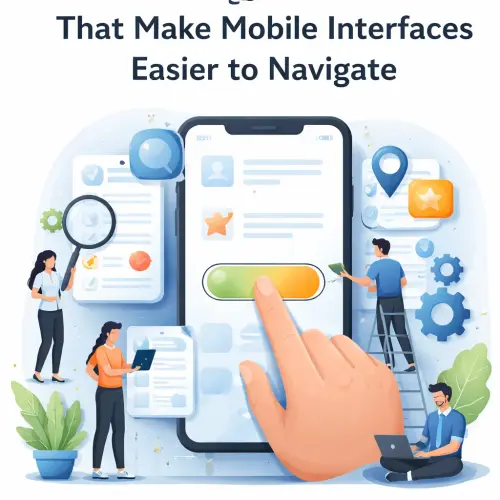
Why Prioritizing Mobile Interfaces Easier to Navigate Boosts User Experience
Mobile users are often on the go, distracted, or impatient. A confusing navigation menu can cause them to abandon an app or site within seconds. Research from the Nielsen Norman Group shows that users frequently miss or misunderstand poorly designed mobile menus. By making mobile interfaces easier to navigate, you reduce cognitive load and help people complete tasks—whether it’s buying a product, finding a contact, or reading an article—without frustration. For a related guide, see 7 Smart Ways Simpler Menus Help Casual Players Navigate.
Additionally, search engines like Google use mobile usability as a ranking factor. A site that feels clunky on mobile may lose organic traffic. The same design choices that improve user experience also signal to algorithms that your content is trustworthy and accessible. In short, investing in mobile UI design tips is a win for both humans and search bots.
7 Key Design Principles for Mobile Interfaces Easier to Navigate
1. Optimize for Thumb-Friendly Zones
The human thumb has a natural reach zone. Studies show that the center and lower parts of the screen are easiest for one-handed use. Placing primary navigation elements—like menu buttons, CTAs, or search bars—within this area makes mobile interfaces easier to navigate without stretching or shifting grip.
Example of poor design: A hamburger menu icon in the top-left corner forces users to reach awkwardly or use two hands.
Good design: Spotify places its main navigation tabs (Home, Search, Your Library) at the bottom of the screen, right where thumbs naturally rest.
Practical tip:
Use a heat map test or finger tracking to confirm that your key controls sit within the thumb’s “sweet spot.” Avoid placing critical actions in the top-left or top-right corners on larger screens.
2. Use Clear, Descriptive Labels
Icons alone can be ambiguous. Adding concise text labels removes guesswork and makes mobile interfaces easier to navigate for first-time visitors. For instance, a shopping cart icon might be clear to some, but adding the word “Cart” ensures everyone understands.
Example of poor design: A gear icon labeled only with “Settings” is fine, but if the icon is tiny, generic (like a cog), or placed in a cluster, users may overlook it.
Good design: Airbnb’s bottom navigation uses both icons and short labels: “Explore,” “Wishlists,” “Trips,” “Inbox,” and “Profile.” Each option is immediately understandable.
3. Maintain Consistent Iconography and Placement
Once users learn that a heart icon means “like” or that a magnifying glass opens search, don’t change it on the next screen. Consistency in symbols and their positions across all pages reduces confusion and reinforces familiarity, which is a cornerstone of making mobile interfaces easier to navigate.
Example of poor design: A news app that uses a hamburger menu on the home screen but switches to a bottom tab bar on article pages forces users to re-learn navigation each time.
Good design: Instagram’s bottom tab bar stays identical whether you’re on the feed, explore, or profile page. The only change is the highlighted tab, which is instantly recognizable.
4. Minimize the Number of Navigation Options
Too many choices overwhelm users and slow decision-making. For mobile interfaces easier to navigate, limit the primary navigation to five items or fewer. This aligns with Miller’s Law (7±2 chunks) and the practical constraints of a small screen.
Example of poor design: A banking app that lists nine options in a hamburger menu without grouping them.
Good design: PayPal’s mobile app uses four main tabs (Home, Activity, Send, Request) and a simple “More” button for secondary actions. The core tasks are one tap away, reducing friction.
5. Design for Touch Targets of at Least 48×48 Pixels
Small buttons are the enemy of easy mobile navigation. The average adult finger pad is 10–14mm wide, so touch targets should be at least 48×48 pixels (about 9mm) with adequate spacing between them. This prevents accidental taps and makes mobile interfaces easier to navigate for users with larger fingers or motor impairments.
Example of poor design: A checkout page with a tiny “Submit” button squeezed between two larger fields.
Good design: Apple’s iOS guidelines recommend a minimum target size of 44×44 points (roughly 48px on most screens). The “Buy” button on the App Store is always large and generously padded.
6. Provide Visual Feedback for Every Interaction
When a user taps a button, they need instant confirmation that the system registered the action. Micro-interactions—like a button color change, a subtle vibration, or a loading spinner—reassure users and make mobile interfaces easier to navigate by reducing uncertainty. For a related guide, see 5 Features That Make Casino Systems Easier to Use (Proven).
Example of poor design: Tapping a menu link and seeing no visual change until the new page loads (which can take seconds).
Good design: Gmail’s mobile app highlights the tapped email in blue and shows a brief animation before opening it. Users feel in control.
7. Implement Logical Information Hierarchy
Users scan mobile interfaces differently than desktops. A clear hierarchy—using size, color, and spacing—guides the eye to the most important elements first. This principle is essential for mobile interfaces easier to navigate because it reduces scanning effort.
Example of poor design: A product page where “Add to Cart” is the same size as the “Learn More” link, buried in a wall of text.
Good design: Amazon’s mobile product page highlights the price in large bold text, followed by a prominent yellow “Add to Cart” button, while secondary details like shipping info are smaller and below.
Contrasting Poor vs. Good Mobile Interface Navigation
To solidify these concepts, here’s a quick comparison table of common design patterns:
| Element | Poor Design | Good Design |
|---|---|---|
| Navigation bar position | Top of the screen (hard to reach) | Bottom of the screen (thumb-friendly) |
| Label visibility | Icons only, no text | Icons + short labels |
| Number of menu items | 7+ items in a side menu | 4–5 items in a tab bar |
| Touch target size | 30×30 pixels | 48×48 pixels minimum |
| Feedback on tap | No visual change | Color change or subtle animation |
| Visual hierarchy | All buttons same size | Primary action is largest |
Best Practices for Implementing These Mobile UI Design Tips
Adopting the seven principles above is a great start, but a few extra considerations will ensure long-term success:
- Test with real users early and often. A design that seems intuitive to you may confuse others. Use tools like UsabilityHub or UserTesting to validate your navigation.
- Consider accessibility. Ensure sufficient color contrast, support screen readers with proper ARIA labels, and allow font resizing without breaking layout.
- Optimize for one-handed use. Most people hold their phone in one hand. Place interactive elements where the thumb can reach without extra effort.
- Prioritize content over chrome. Avoid wasting screen real estate on decorative elements that don’t aid navigation.
- A/B test navigation patterns. A bottom tab bar might outperform a hamburger menu for your audience. Let data guide your decisions.
Useful Resources
For further reading on designing mobile interfaces easier to navigate, check these authoritative sources:
- Nielsen Norman Group: Mobile Navigation Patterns – In-depth research and examples of effective mobile menus.
- Apple Human Interface Guidelines: Navigation – Official best practices from Apple for iOS app navigation.
By applying these seven design choices, you can transform a frustrating tap-and-swipe experience into one where mobile interfaces easier to navigate become the norm. Start with one principle today—perhaps adjusting your button sizes or moving navigation to the bottom—and test the impact. Your users will thank you, and your conversion rates will reflect it.
Frequently Asked Questions About mobile interfaces easier to navigate
What is the most important factor for making mobile interfaces easier to navigate?
Consistency is key. When icons, labels, and navigation patterns behave predictably across all screens, users learn quickly and feel confident. Without consistency, even the most well-designed interface becomes confusing.
Should I use a hamburger menu or bottom tab bar?
Bottom tab bars are generally preferred for primary navigation because they are thumb-friendly and always visible. Hamburger menus hide options and add an extra tap, which can reduce discoverability. Use a hamburger menu only for secondary or rarely used features.
How many navigation items should I have?
Limit primary navigation to five items or fewer. This fits comfortably on a mobile screen without overcrowding and aligns with cognitive limits. If you have more options, group them under a “More” or “Menu” button.
What is the ideal touch target size for mobile?
At least 48×48 pixels (approximately 9mm). This size accommodates the average finger pad and reduces accidental taps. For critical actions like “Checkout,” consider a larger target for added safety.
Do I always need text labels next to icons?
Yes, unless the icon is universally understood (e.g., a house for “Home”). Even then, adding a short label eliminates ambiguity and helps first-time users. It also improves accessibility for screen readers.
How can I test if my navigation is easy to use?
Conduct usability testing with representative users. Ask them to complete specific tasks (e.g., “Find the product page for a red dress”). Observe where they hesitate or tap incorrectly. Tools like Hotjar or Crazy Egg can also provide heat maps of user interactions.
What feedback should users get after tapping a button?
Immediate visual or haptic feedback, such as a color change, button press animation, or a subtle vibration. This confirms the system registered the action and reduces perceived lag. Without feedback, users may tap repeatedly out of uncertainty.
Is a sticky navigation bar a good idea on mobile?
A sticky bottom navigation bar (or a persistent top bar) can be helpful, as long as it doesn’t take up too much screen real estate. A thin, persistent bar with core actions is acceptable, while a large header can block content and frustrate users.
Should I hide navigation behind gestures?
Gestures can be elegant but require discoverability. Avoid hiding primary navigation behind swipe or long-press actions unless you have a strong reason. Users may never find them. Use gestures for optional shortcuts, not core functionality.
How does font size affect navigation?
Small fonts strain readability and force users to zoom, which disrupts the layout. Use a minimum of 16px for body text and larger sizes for navigation labels. Dynamic type (supporting system font scaling) is even better for accessibility.
What is “thumb zone” and why does it matter?
The thumb zone is the area of the screen most comfortably reached with one thumb. For a typical phone, this is a curve around the bottom center and lower sides. Placing navigation elements outside this zone forces users to stretch or use two hands, making interfaces less usable.
Can I use a search bar as a primary navigation element?
Yes, if your app or site is content-heavy (like a recipe database or e-commerce store). A prominent search bar near the top can be the quickest way for users to find what they need. Just ensure it’s supported by a secondary navigation for browsing.
How do I handle very long lists of navigation items?
Use categorization. Group related items under logical headings or collapsible sections. A two-level navigation (e.g., “Products > Shoes > Running”) can keep the main menu clean while still offering depth. Avoid scrolling horizontally for navigation.
What role does color play in navigation usability?
Color can differentiate active vs. inactive states, highlight calls to action, and convey hierarchy. However, rely on more than just color—use text labels, icons, or spacing so that colorblind users can still navigate.
Is it okay to use custom icons in mobile navigation?
Yes, but test them first. Custom icons should be immediately recognizable or paired with clear labels. Avoid abstract shapes that require learning. Stick to well-known conventions (e.g., magnifying glass for search) unless you have a strong brand reason not to.
How does page loading speed affect navigation perception?
Slow load times make navigation feel broken. Users may think they tapped incorrectly and waste time re-tapping. Optimize images, use lazy loading, and minimize server response times so that navigation feels instant. A delay over 300ms can feel sluggish.
Should I include a “Home” button in mobile navigation?
Yes, if your app or site has multiple sections. A dedicated “Home” button gives users a safe reset point. Place it in a consistent spot—usually the first tab in a bottom bar or the app icon in the top bar.
How do I handle navigation for left-handed users?
Many mobile designs are right-biased. To be inclusive, consider offering a left-handed mode that flips the navigation orientation. Alternatively, place critical controls in the center and bottom of the screen, which works well for both hands.
What’s the biggest mistake designers make with mobile navigation?
Assuming that a design works because it worked on desktop. Mobile navigation requires different priorities: one-handed usage, smaller targets, minimal clutter, and contextual placement. Porting a desktop nav directly to mobile almost always leads to poor usability.
Where can I learn more about mobile UX design?
Start with the Nielsen Norman Group and Apple’s Human Interface Guidelines. Books such as “Mobile Design Pattern Gallery” by Theresa Neil and “Don’t Make Me Think” by Steve Krug are also excellent resources.

Natalie Yap is a seasoned expert in the iGaming industry, with over nine years of hands-on experience reviewing and analyzing the top iGaming platforms specialize for Asian Gamers. A graduate in University of the Philippines with a degree in Bachelor of Business Administration in Marketing and also studied Internet Technology. Natalie focuses on platforms operating outside the Gambling Commission’s Jurisdiction, helping players identify secure, licensed sites that offer wide betting limits, fast and hassle-free withdrawals, and support for cryptocurrency transactions.
My in-depth evaluations cover everything from game variety and user interface to customer service and bonus structures. Natalie is passionate about guiding both new and experienced players toward trusted, high-reward casino experiences that combine entertainment, innovation, and financial safety.